
GAIB x Camp | Robotic Data as Intellectual Property: How GAIB and Camp Network Are Building a New Economy On-Chain

I. Introduction: The Next Frontier of AI - Embodied Intelligence
AI is undergoing a profound transformation, moving beyond the digital world of text and images into the physical world. This new frontier is called “embodied AI.” Unlike LLMs that master language or image models that learn from pixels, embodied intelligence gives AI systems (from autonomous vehicles to sophisticated humanoids) the ability to interact with and operate within our complex, 3D environment. To succeed, these systems need a deep, intuitive grasp of physics, spatial awareness, and real-world cause and effect.
These capabilities can't be learned from scraping websites. It requires a completely different, far more valuable kind of fuel: robotic data. This specialized data is the critical bridge that allows an AI model to transition from theoretical knowledge to practical, physical execution. It's the language of the real world, and it is incredibly difficult to acquire.
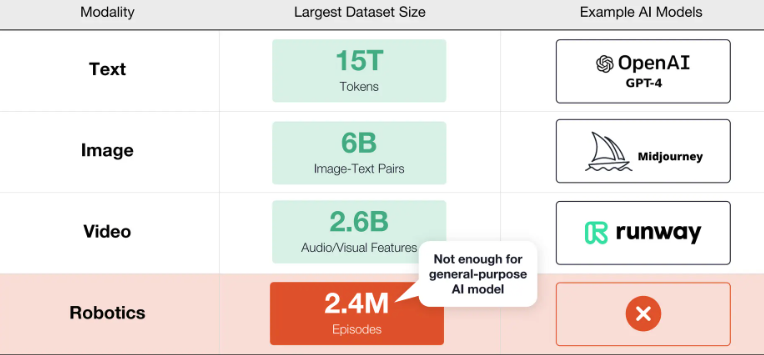
While LLMs have the all-you-can-eat data buffet of the internet, high-fidelity robotic data must be created through painstaking effort. There are generally two paths:
- Real-World Collection (Teleoperation): One of the most effective methods is called teleoperation, where a skilled human expert remotely controls a robot, guiding it through complex tasks. The robot records every movement, sensor reading, and decision, creating a rich, real-world instruction manual. This process is incredibly powerful but also slow and extremely expensive, demanding significant human capital and time.
- Synthetic Generation (Simulation): The alternative is to generate simulated data in a virtual environment. While this is faster, cheaper, and can produce massive volumes of data, it often falls victim to the "sim-to-real gap"—the subtle but critical differences between virtual physics and the messy, unpredictable nature of the real world.
This fundamental scarcity and the high cost of acquisition (whether through capital-intensive hardware deployments or expert-led teleoperation) elevate robotic data from a simple training ingredient to a highly strategic and defensible intellectual property asset.
II. Robotic Data: The Next Frontier of Digital IP
A robot isn’t just another app scouring the cloud: it’s a physical system learning from experience. As Scale AI puts it: “robotic data can’t be scraped from the web. It must be collected, one interaction at a time, in the real world.” In short, embodied data is painfully hard and expensive to get.
- No shortcuts: Web AI can piggyback on Reddit and Wikipedia, but robots can’t cheat. They need real-world motion data, there’s no “copy-paste from internet” option.
- Huge data needs: Robots deal with cameras, gyros, force sensors, speech audio – multi-modal streams far richer than a text token. Researchers estimate that training a physical AI model requires orders of magnitude more data than GPT did. CACM notes “training an [embodied AI] model requires significantly more robotic data… extremely challenging and costly to collect.”
- Data silos: Today, most robotic data sits locked in labs or companies’ vaults, not on the Internet. It’s often highly specialized and proprietary. Physical-world data is painful to collect, impossible to license, off-chain, unaccounted for, and unrewarded. In other words, there’s no easy marketplace for it yet. This makes every motion capture sequence or drive log its own rare commodity.
From Data Scarcity to Digital Identity: The Rise of the “Elonbot”
As the struggle for robotic data intensifies, another issue emerges; the question of who owns the data that defines us. Treating robotic data as IP isn’t just a technical issue, it’s a budding legal battle. We’ve already seen artists and authors suing AI companies because their copyrighted work was used without permission (and compensation) for training. Why would it be different for your movements and personality?
Imagine “Elonbot”, a fictional humanoid trained on every public Musk interview, every Tesla board meeting, every wry Twitter post. This robot walks with Musk’s loping stride, talks like him, even mimics his decision-making quirks. Suddenly Musk’s identity has become a commercially usable data set.
It raises a thought: if someone built Elonbot without Elon’s say-so, should he get royalties?
Every time Elonbot gives a keynote speech or closes a billion-dollar deal, who earned that value? Under U.S. law the concept of “right of publicity” is at hand: individuals generally have the exclusive right to license their name, image, and likeness for commercial use. Lawmakers are already proposing to extend this to digital replicas: the draft “NO FAKES Act” would give people exclusive control over any AI-generated copy of their voice or appearance. In other words, an Elonbot clearly sounds like Elon and looks like Elon Musk (or his estate) would arguably have a legal claim to license that data.

On the flip side, tech moguls sometimes ridicule IP protections in theory. Recall Elon himself retweeted Twitter co-founder Jack Dorsey’s quip to “delete all IP law,” vowing to scrub copyright and even publicity rights. But talk is cheap. In practice, if one of Musk’s investors saw an algorithmic clone of Elon wheeling-and-dealing, they’d likely write a check for permission rather than let him claim “the right of the strong” as a defense. Paradoxically, the same Musk who touts open-source patents might one day want royalties for his own style.
The moral: robotic data can embody a person’s creative expression. Trainers of Elonbot have effectively commoditized Musk’s gait and personas. That’s conceptually no different from sampling a musician’s performance. As one crypto lawyer put it, any unauthorized use of someone’s persona in a “highly realistic electronic representation” should trigger a license fee. So why shouldn’t Elon get a cut every time Elonbot aces a TED Talk?
III. Blockchain to the Rescue: Camp Network’s Vision
How do we protect and monetize these new kinds of IP?
Enter blockchain – specifically, platforms like Camp Network that aim to make data licensing transparent and automatic. Camp is positioning itself as an “autonomous IP layer” for AI. In practice that means every piece of embodied data – say, a clip of Musk’s speech or a LiDAR trace of his walk – can be registered on-chain with an unforgeable timestamp and owner identity. Think of it as a global ledger of who owns what data, and how it can be used. Camp’s vision is that robot developers would only train on data that has a clear on-chain license attached.
Camp’s Layer-1 blockchain offers programmable licensing: creators can define the terms of use via smart contracts, and those terms stick to the data forever. For example, a voice clip of Musk could be registered with a license that says “training allowed but commercial use requires 10% royalties”. If an AI or robot queries the Camp registry, the chain will say “this data is owned by Musk, he wants royalties”. Every time someone uses that data, the smart contract can automatically route payments back to the owner. In effect, the data carries its own royalty code.
This is all wrapped in Camp’s “Proof of Provenance” idea: every data asset has a traceable lineage on-chain. If your robot arm data flows into a gait model, which then produces a policy, the entire family tree of IP is recorded. This allows enforcement and auditing – anyone can verify where a model learned a behavior, and see that licenses were respected. Some crypto coverage notes that Camp’s architecture even uses a special consensus mechanism to verify IP origin, enabling automated royalty settlements without lawsuits. In short, Camp is literally trying to build a self-enforcing rights-management system for embodied data.
In practical terms, Camp Network already touts a registry for any creative IP (artwork, music, data) where owners post their copyrights on-chain. The idea is to extend this to the physical world. As one Camp report explains, with their system “AI utilizes [on-chain] data” and “royalties get automatically settled according to preset conditions”. In other words: Robot wants to chew on data → Robot’s AI checks the smart contracts → money moves to data owners.
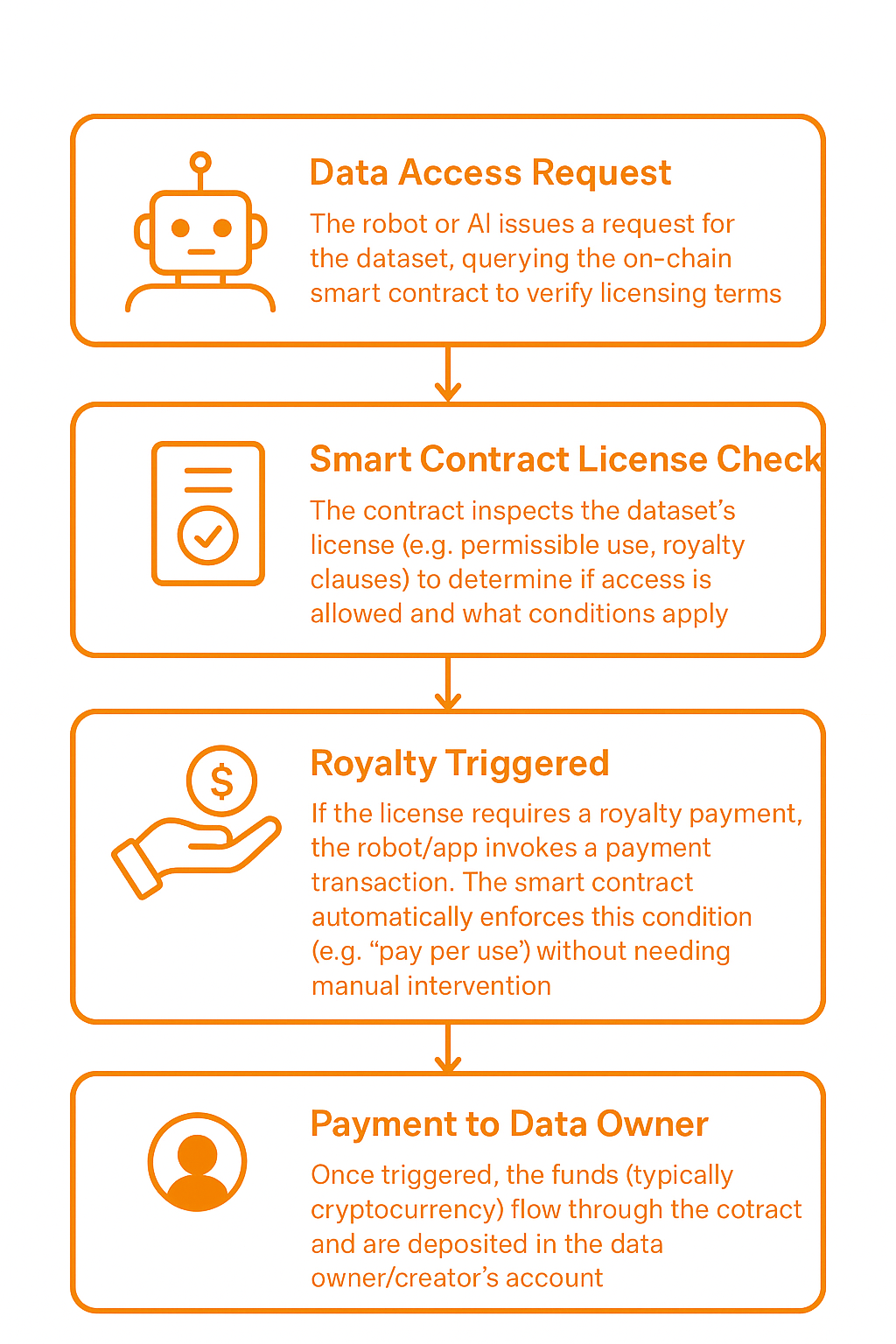
Critically, this kind of system could make “robotic data” into a real economy. Rather than free appropriation, you get verifiable provenance, licensing fees, and an open market for sensor streams. In Camp’s view, that will incentivize people to share their unique datasets: you could license your self-driving car’s route logs or your factory’s robotic assembly data, earning tokens every time a model uses them. Because it’s on-chain, payments happen trustlessly. We’re talking about converting motions and voices into tradable assets – a far cry from today’s “take what you want” AI pipelines.
Like oil in the 19th century or user clickstream in the 2000s, embodied data is poised to become the next asset class.
Who controls it will matter enormously. If companies harvest it without consent, creative and human value get siphoned for free. If instead people can register and license their unique data, we get a kind of market-led incentive: better robots plus better pay for creators. In that sense, robotic data is IP, and its owners deserve protection and payment – just like musicians and authors. After all, why should Musk’s gait be any less his property than Jimi Hendrix’s guitar licks?
Big tech has already built an empire on exploiting data created by the rest of us. Now the shoe’s on the other foot. The “next Silicon Valley” might be in your living room, where every captured motion or spoken word can fuel AI – and should also fuel your bank account if it’s your performance. Platforms like Camp Network are racing to encode that future into code: they aim to transform odd sensor readings into programmable, provable IP assets.
It may sound like a nerdy pipe dream, but there’s precedent for such shifts. When Napster forced music into a paid system (hello, Spotify), we saw industry growth. When blockchain tokenized digital art, Beeple sold for millions. The same thing is coming for data. In ten years the phrase “robotic data” might trigger thoughts of market value, not just science fiction.
The question isn’t if robotic data will be valuable – that’s already baked in. It’s who will own it and how they’ll be paid.
IV. GAIB's Contribution: Transforming IP into a Yield-Generating Asset
Now, owning an asset is one thing, but unlocking its true financial potential is another. A deed to a property is valuable and builds the foundation, but it’s the ability to rent it out, develop it, or borrow against it that generates wealth.
The real question is: how do you turn the potential value of that data into the upfront capital needed to generate it in the first place?
This is the problem GAIB is tackling. We are not a marketplace for data, nor do we license or own any IP. Instead, GAIB is building the financial infrastructure to fund the creators of this data. We’re exploring a new model to fuel the growth of embodied AI.
Here could be how we're approaching it – Financing the Data Factories:
Think of us as a financial partner for the builders. We provide capital to robotics companies so they can deploy their hardware—the drones, arms, and sensors—out in the real world. The operators then do what they do best: collect, curate, and monetize their unique datasets through sales or licensing. GAIB investors, in turn, are repaid from that resulting cash flow, creating a self-sustaining loop where capital directly fuels the creation of valuable, real-world data.
Taking one more step beyond, this leads to a more imaginative, game-changing question: What if we could treat verified robotic data as a true financial asset—one you can borrow against?
Think about how a mortgage works: you use a physical home as collateral to secure a loan from a bank. The bank trusts the value of the house. What if we could enable that same financial primitive for the digital age? What if a robotics startup could collateralize its future data stream—verified on-chain by Camp—to secure the funding it needs to grow today?
This might unlock a wave of innovation. Imagine a world where:
- Startups get non-dilutive funding. Brilliant robotics teams could secure capital without giving away equity, simply by leveraging the value of the data they are uniquely positioned to create.
- New financial products emerge. We could see the creation of data-backed loans, yield instruments based on the performance of data-generating robot fleets, and entirely new markets for valuing and financing IP before it's even sold.
- Capital flows more efficiently. Lenders could more accurately price risk and value, knowing the underlying data asset is real, unique, and has a verifiable history.
GAIB's vision is to pioneer this new financial landscape. We're not just helping people monetize data that already exists; we're building the engine to finance the creation of data that will power the next generation of intelligent machines.
V. The GAIB x Camp Network Synergy: Building the Embodied AI Economy
The partnership between GAIB and Camp Network isn't just a collaboration; it's the creation of a complete, end-to-end robotic data ecosystem for the future of embodied AI.
- Camp Network is the Layer of Truth. It provides the Enforcement Layer, establishing the undeniable provenance, ownership, and IP rights of robotic data. It answers the questions: “Where did this data come from?” and “Who has the right to use it?”
- GAIB is the Layer of Value. We provide the Financial Layer, taking that verified IP and plugging it into a dynamic market. We answer the questions: “What is this data worth?” and “How can I generate a return from it?”
This powerful synergy creates a virtuous cycle—a flywheel—that will accelerate the entire field of robotics and embodied AI.
More Incentives → More Data → Smarter Robots
By providing a clear and reliable path to monetization (GAIB) built on a foundation of trust and verification (Camp), we create powerful incentives for individuals and companies to go out into the real world and collect the high-quality, multimodal data that is so desperately needed. This influx of data will directly fuel the development of more capable, intelligent, and useful robots, creating even more demand for the data assets on the network.
This unified ecosystem finally solves the core challenges that have held back the data economy: lack of trust, unclear ownership, and inefficient monetization.
About Camp Network
Camp Network is the Autonomous IP Layer designed to power the future of IP and AI. As a Layer-1 blockchain, Camp is pioneering the Proof of Provenance Protocol, embedding IP registration, licensing, and royalty distribution directly at the execution layer while optimizing for agentic-driven workflows. Users can tokenize any form of IP, fine-tune and deploy AI agents, and tokenize these agents onchain for broader ecosystem use. For more information, visit www.campnetwork.xyz
About GAIB
GAIB is the economic layer for AI infrastructure, bringing compute and robotic economies onchain. By tokenizing enterprise-grade GPUs and robotics assets with their underlying operational values, GAIB provides capital access for AI infrastructure operators and transparent exposure for participants. Through AID, its AI-backed synthetic dollar, users can engage in the digital AI economy and earn ecosystem rewards via sAID staking. GAIB connects AI infrastructure with decentralized finance—unlocking new opportunities where technology meets capital. For more information, visit www.gaib.ai.